
Local SEO for Small Businesses in 2026
A great website does little good when local customers cannot find it.
That is why local SEO has become so important for small businesses.
Local SEO helps a business appear when nearby customers search for products or services. Those searches often take place through Google Search and Google Maps.
A homeowner may search for a plumber near Melbourne, Florida. A family may look for restaurants in Viera. A business owner may search for IT support in Brevard County.
These searches have something important in common. The person searching usually needs a product or service soon.
Local SEO for small business helps connect that demand with the right local company.
The process includes much more than adding a city name to a website. Google Business Profile, reviews, website content, business information, technical SEO, and local trust signals all play a role.
This guide explains how those pieces work together.
What Is Local SEO for Small Business?
Local SEO is the process of improving online visibility for searches tied to an area.
Traditional SEO may target a broad phrase such as “managed WordPress hosting.”
Local SEO may target searches such as “managed WordPress hosting in Brevard County” or “website management near me.”
The goal is not just more website traffic.
The real goal is visibility among people who may become customers.
Local SEO can help service companies, restaurants, medical offices, stores, contractors, professional firms, and many other local businesses.
A strong local search presence makes it easier for customers to find business hours, services, reviews, directions, phone numbers, and website information.
Why Google Maps Matters for Local Businesses
Google Maps has become a major part of local search.
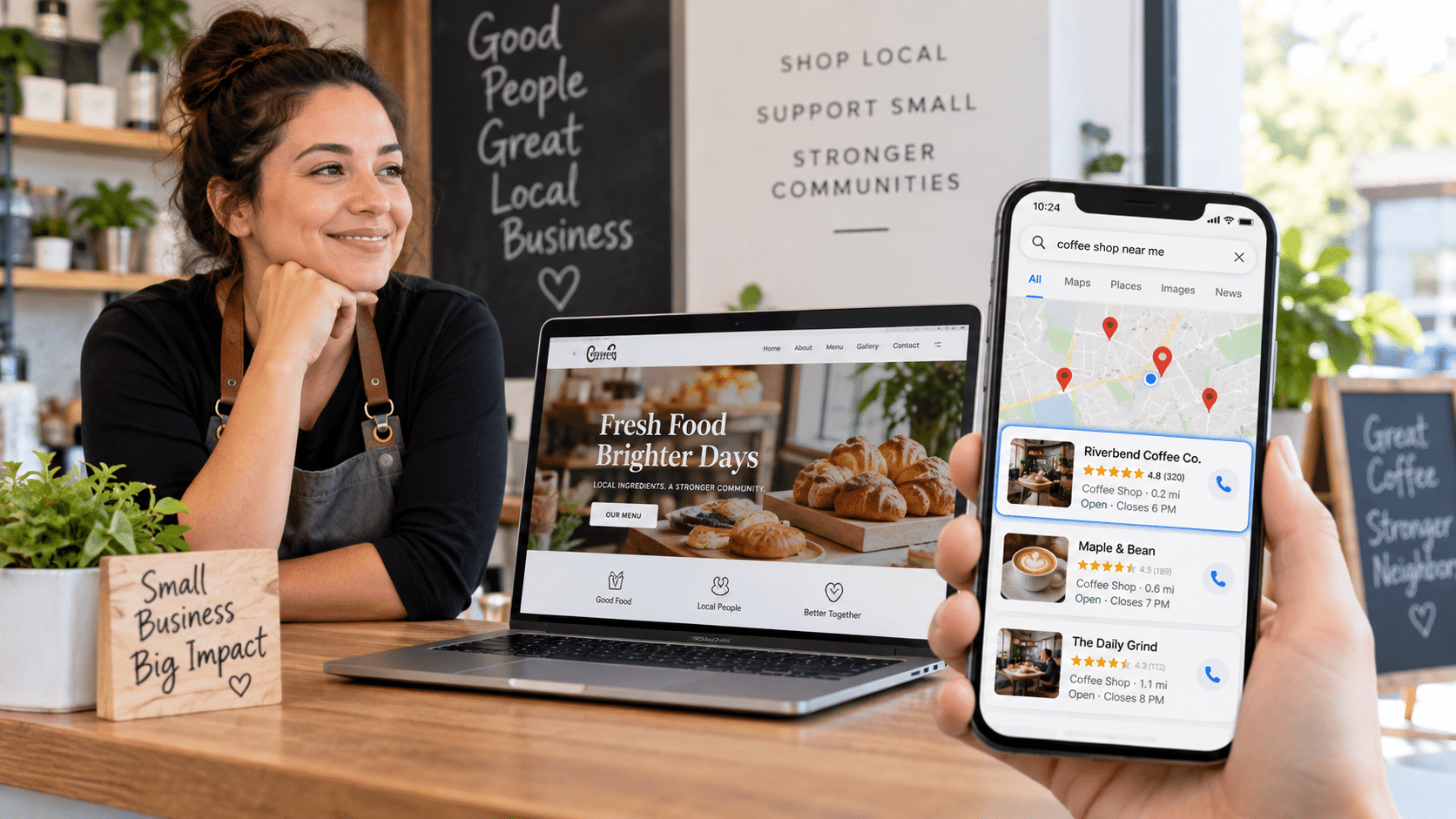
A search for a nearby business can show a map with several business listings before many standard website results appear.
Each listing may include reviews, hours, photos, directions, services, and contact details.
Google Business Profile allows eligible businesses to manage much of this information at no cost. Learn more about Google Business Profile
This makes a Google Business Profile an important part of local SEO.
It should not replace a business website.
A Business Profile and website serve different roles. The profile gives quick business information. The website provides more room to explain services, answer questions, build trust, and turn visitors into leads.
The strongest local presence connects both.
How Google Determines Local Search Results
Google explains that local search results are mainly based on three factors: relevance, distance, and prominence. Read Google guidance on local ranking
Relevance measures how closely a business matches a search.
A complete profile helps Google understand the products and services offered.
Distance considers how far a business is from the person searching or the location named in the search.
A business cannot control every distance factor.
Prominence relates to how well known a business appears to be.
Google states that links, articles, directories, reviews, and other information can contribute to prominence.
Local SEO should address the factors a business can control instead of searching for shortcuts.
Start With a Complete Google Business Profile
An incomplete Google Business Profile creates missed opportunities.
Basic information should remain accurate and current.
Important items include the business name, phone number, website, hours, business category, service areas, and address when applicable.
The profile should also explain what the business offers.
A restaurant might include dining options and menu information. A contractor may list major services. A web company may list website design, hosting, maintenance, and SEO.
The main business category also matters.
The category should represent the main business activity rather than every service offered.
Google recommends complete and accurate business information because it can help a business appear in relevant local results.
Keep Business Information Consistent
Search engines gather business information from many sources.
A phone number may appear on the website, Google Business Profile, Facebook, local directories, trade sites, and other listings.
Conflicting information can create confusion.
A business should use the same core name, address, phone number, and website information wherever possible.
Old addresses should be corrected. Closed locations should not remain active without a valid reason. Old phone numbers should be removed from important listings.
Consistency also helps customers.
A person should not have to guess which phone number or business hours are correct.
Local SEO works best when the same clear information appears across the main online presence.
Customer Reviews Build More Than Trust
Reviews influence purchasing decisions.
A business with recent, thoughtful reviews can make a stronger first impression than a competitor with little customer feedback.
Google also states that review count and review scores can affect local search ranking.
Businesses should ask real customers for honest reviews.
Buying reviews is not a sound SEO strategy. Neither is creating fake accounts or rewarding only positive feedback.
Reviews should reflect real customer experiences.
Responses also matter.
A short thank you can show that customer feedback receives attention. A calm response to a negative review can show how a business handles problems.
Review management is both an SEO task and a customer service task.
Photos Help Customers Understand the Business
Local search is visual.
Photos can help customers see a location, product, completed project, team, menu item, office, or service result.
Google recommends adding photos and videos to Business Profiles.
Useful images should represent the real business.
A restaurant can show popular meals. A roofing company can show completed roofs. A retail store can show products. A professional office can show the location and staff.
New photos also help keep the profile useful as the business changes.
The same principle applies to the website.
Real photos often communicate more trust than a page filled only with stock images.
The Website Is Still a Major Part of Local SEO
Google Business Profile receives a great deal of attention in local SEO discussions.
The website should not be ignored.
Google uses information from across the web when evaluating businesses. Standard search visibility also contributes to local prominence.
A well built website explains services in far greater detail than a business listing can.
Each main service should have useful content.
For example, a home service company offering roofing, gutters, siding, and storm repair should not hide every service inside one short paragraph.
Clear service pages help visitors and search engines understand the business.
A website should also work well on phones, load quickly, use secure HTTPS connections, and provide clear contact options.
BrevardHost.net combines website design, hosting, security, maintenance, and ongoing support through its Fully Managed Websites service.
Build Useful Service Pages
Service pages are one of the strongest parts of a local business website.
Each important service deserves enough information to answer basic customer questions.
A useful service page can explain what the service includes, who may need it, common problems, the service process, locations served, and ways to request help.
Content should be written for people first.
Repeating the same keyword dozens of times does not make a page more useful.
Consider a local air conditioning company.
A page titled “Air Conditioning Repair” can explain common repair problems and service options.
A separate page can cover system replacement.
Another page may cover maintenance.
This structure helps search engines understand each service and gives customers a better place to find answers.
Use Local Content That Has Real Value
Adding local information can help search engines understand where a business operates.
The content still needs to be useful.
A company serving Melbourne, Palm Bay, Cocoa, Titusville, Viera, and other Brevard County communities can mention those areas where appropriate.
That does not mean creating dozens of nearly identical pages with different city names.
Thin location pages offer little value.
A strong location page should contain information that relates to actual services in that area.
Local blog content can also help.
A landscaper might explain lawn care concerns common to Central Florida. A roofing company might discuss storm preparation. A restaurant might publish information about local events or seasonal menu changes.
Local content should answer real questions rather than exist only for search engines.
Add Local Business Structured Data
Structured data gives search engines added information about page content.
Google supports LocalBusiness structured data for businesses with a local presence. It can include information such as business type, address, hours, and other details. View Google’s LocalBusiness structured data guide
This code is usually not visible to website visitors.
It sits behind the page and helps machines understand important business details.
Structured data must match the visible business information.
It should not contain false locations, fake ratings, or services that the business does not offer.
Google also recommends testing structured data before relying on it.
Schema is helpful, but it is not a replacement for useful content or accurate business information.
Local Links and Citations Can Strengthen Visibility
A local business exists within a community.
Online search should reflect that real connection.
Links and mentions from useful local sources can help build credibility.
Examples may include chambers of commerce, trade groups, local news sites, community groups, suppliers, professional groups, charities, or business partners.
The goal is quality rather than quantity.
Hundreds of low quality directory listings are not better than a few strong and accurate references.
Business information on important directories should also remain current.
A local citation is simply an online reference to a business and its contact information.
Good citations help create a consistent online identity.
Track Leads Instead of Watching Rankings Alone
Rankings are useful, but rankings are not the final goal.
A business needs calls, contact forms, bookings, store visits, quote requests, and sales.
Local SEO reporting should connect visibility with business activity.
Useful measurements include Google Business Profile interactions, organic website visits, contact form submissions, phone calls, important keyword positions, and traffic to major service pages.
Search rankings can also change based on location.
A business may appear differently to a person five miles away than to a person twenty miles away.
This is one reason local SEO should not be judged from one personal Google search.
Tracking results over time provides a clearer picture.
Avoid Common Local SEO Mistakes
Several common mistakes can limit local search results.
Keyword stuffing is one.
A page does not need to repeat “best plumber in Melbourne Florida” twenty times.
Creating fake locations is another problem.
A service area does not become a real office simply because a city name appears on a page.
Ignoring reviews can also weaken trust.
Outdated hours, broken website links, old phone numbers, duplicate listings, and poor mobile pages create more problems.
Local SEO works best when the business information is honest, clear, useful, and maintained over time.
Local SEO Also Supports AI Search
Search is changing as Google and other platforms add more AI based answers.
That does not make local SEO obsolete.
Clear business information becomes even more important when search systems must understand what a company does and where services are available.
Strong service pages, accurate business details, trusted reviews, structured data, and useful content create a better information base.
BrevardHost.net covered this connection in the guide AI Search Optimization for Small Businesses in 2026.
The key lesson remains simple.
Businesses do not need to abandon standard SEO because AI search exists.
A strong search foundation supports both traditional and newer forms of search.
Local SEO Requires Ongoing Work
Local SEO is not a one time setup.
Business hours change. Services change. Competitors change. Reviews arrive. Websites need updates. Search results also change.
A neglected profile can slowly become inaccurate.
A neglected website can develop broken pages, outdated content, security problems, or weak search performance.
Regular maintenance helps prevent those issues.
Local SEO management may include keyword research, website updates, content work, business listing management, review monitoring, technical checks, schema, reporting, and competitive research.
BrevardHost.net provides Fully Managed SEO services